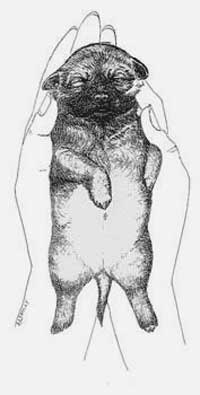
Early Neurological Stimulation
By Dr. Carmen L. Battaglia
Surprising as it may
seem, it isn't capacity that explains the differences that exist between individuals because most seem to have far more capacity
than they will ever use. The differences that exist between individuals seem to be related to something else. The ones who
achieve and outperform others seem to have within themselves the ability to use hidden resources. In other words, it's what
they are able to do with what they have that makes the difference.
In many animal breeding programs, the entire process
of selection and management is founded on the belief that performance is inherited. Attempts to analyze the genetics of performance
in a systematic way have involved some distinguished names such as Charles Darwin and Francis Galton. But it has only been
in recent decades that good estimates of heritability of performance have been based on adequate data. Cunningham, (1991)
in his study of horses, found that only by using Timeform data, and measuring groups of half brothers and half sisters could
good estimates of performance be determined. His data shows that performance for speed is about 35% heritable. In other words,
only about 35% of all the variation that is observed in track performance is controlled by heritable factors, the remaining
65% is attributable to other influences, such as training, management and nutrition. Cunningham's work while limited to horses,
provides a good basis for understanding how much breeders can attribute to the genetics and the pedigrees.
Researchers
have studied these phenomena and have looked for new ways to stimulate individuals in order to improve their natural abilities.
Some of the methods discovered have produced life long lasting effects. Today many of the differences between individuals
can now be explained by the use of early stimulation methods.
Man for centuries has tried various methods to improve
performance. Some of the methods have stood the test of time, others have not. Those who first conducted research on this
topic believed that the period of early age was a most important time for stimulation because of its rapid growth and development.
Today, we know that early life is a time when the physical immaturity of an organism is susceptible and responsive to a restricted
but important class of stimuli. Because of its importance many studies have focused their efforts on the first few months
of life.
Newborn pups are uniquely different from adults in several respects. When born, their eyes are closed and their
digestive system has a limited capacity requiring periodic stimulation by their dam who routinely licks them in order to promote
digestion. At this age they are only able to smell, suck, and crawl. Body temperature is maintained by snuggling close to
their mother or by crawling into piles with other littermates. During these first few weeks of immobility, researchers noted
that these immature and under-developed canines are sensitive to a restricted class of stimuli which includes thermal and
tactile stimulation, motion and locomotion.
Other mammals such as mice and rats are also born with limitations, and
they also have been found to demonstrate a similar sensitivity to the effects of early stimulation. Studies show that removing
them from their nest for three minutes each day during the first five to ten days of life causes body temperatures to fall
below normal. This mild form of stress is sufficient to stimulate hormonal, adrenal and pituitary systems. When tested later
as adults, these same animals were better able to withstand stress than littermates who were not exposed to the same early
stress exercises. As adults, they responded to stress in "a graded" fashion, while their non-stressed littermates
responded in an "all or nothing way."
Data involving laboratory mice and rats also shows that stress in small
amounts can produce adults who respond maximally. On the other hand, the results gathered from non-stressed littermate show
that they become easily exhausted and are near death if exposed to intense prolonged stress. When tied down so they were unable
to move for twenty-four hours, rats developed severe stomach ulcers, but litter mates exposed to early stress handling were
found to be more resistant to stress tests and did not show evidence of ulcers. A secondary affect was also noticed.
Sexual
maturity was attained sooner in the littermates given early stress exercises. When tested for differences in health and disease,
the stressed animals were found to be more resistant to certain forms of cancer and infectious diseases and could withstand
terminal starvation and exposure to cold for longer periods than their non-stressed littermates.
Other studies involving
early stimulation exercises have been successfully performed on both cats and dogs. In these studies, the Electrical Encephalogram
(EEG) was found to be ideal for measuring the electrical activity in the brain because of its extreme sensitivity to changes
in excitement, emotional stress, muscle tension, changes in oxygen and breathing. EEG measures show that pups and kittens
when given early stimulation exercises mature at faster rates and perform better in certain problem solving tests than non-stimulated
mates.
In the higher level animals the effect of early stimulation exercises have also been studied. The use of surrogate
mothers and familiar objects were tested by both of the Kelloggs and Dr. Yearkes using young chimpanzees. Their pioneer research
shows that the more primates were deprived of stimulation and interaction during early development, the less able they were
to cope, adjust and later adapt to situations as adults.
While experiments have not yet produced specific information
about the optimal amounts of stress needed to make young animals psychologically or physiologically superior, researchers
agree that stress has value. What also is known is that a certain amount of stress for one may be too intense for another,
and that too much stress can retard development. The results show that early stimulation exercises can have positive results
but must be used with caution. In other words, too much stress can cause pathological adversities rather than physical or
psychological superiority.
The U.S. Military in their canine program developed a method that still serves as a guide
to what works. In an effort to improve the performance of dogs used for military purposes, a program called "Bio Sensor"
was developed. Later, it became known to the public as the "Super Dog" Program. Based on years of research, the
military learned that early neurological stimulation exercises could have important and lasting effects. Their studies confirmed
that there are specific time periods early in life when neurological stimulation has optimum results. The first period involves
a window of time that begins at the third day of life and lasts until the sixteenth day. It is believed that because this
interval of time is a period of rapid neurological growth and development, and therefore is of great importance to the individual.
The
"Bio Sensor" program was also concerned with early neurological stimulation in order to give the dog a superior
advantage. Its development utilized six exercises which were designed to stimulate the neurological system. Each workout involved
handling puppies once each day. The workouts required handling them one at a time while performing a series of five exercises.
Listed in order of preference, the handler starts with one pup and stimulates it using each of the five exercises. The handler
completes the series from beginning to end before starting with the next pup.
The handling of each pup once per day
involves the following exercises:
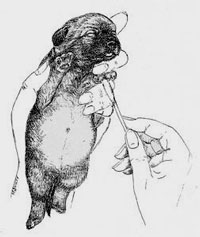
- Tactical stimulation (between toes): Holding the pup in one
hand, the handler gently stimulates (tickles) the pup between the toes on any one foot using a Q-tip. It is not necessary
to see that the pup is feeling the tickle. Time of stimulation 3 - 5 seconds.(Figure 1)
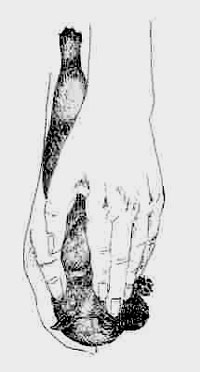
- Head held erect: Uusing both hands, the pup is held perpendicular to the ground, (straight up), so that its head
is directly above its tail. This is an upwards position. Time of stimulation 3 - 5 seconds (Figure 2)
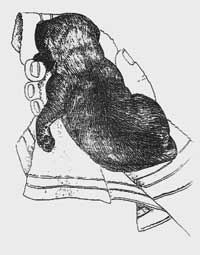
- Head pointed down: Holding the pup firmly with both hands the head is reversed and is pointed downward so that it
is pointing towards the ground. Time of stimulation 3 - 5 seconds(Figure 3)
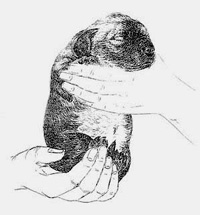
- Supine position: Hold the pup so that its back is resting in the palm of both hands with its muzzle facing the ceiling.
The pup while on its back is allowed to sleep. Time of stimulation 3-5 seconds.(Figure 4)
- Thermal stimulation: Use a damp towel that has been cooled in a refrigerator for at least five minutes. Place the
pup on the towel, feet down. Do not restrain it from moving. Time of stimulation 3-5 seconds. (Figure 5)
These five exercises will produce neurological stimulations, none of which naturally occur during this early
period of life. Experience shows that sometimes pups will resist these exercises, others will appear unconcerned. In either
case a caution is offered to those who plan to use them.
Do not repeat them more than once per day and do not extend
the time beyond that recommended for each exercise. Over stimulation of the neurological system can have adverse and detrimental
results. These exercises impact the neurological system by kicking it into action earlier than would be normally expected,
the result being an increased capacity that later will help to make the difference in its performance. Those who play with
their pups and routinely handle them should continue to do so because the neurological exercises are not substitutions for
routine handling, play socialization or bonding.
Benefits of Stimulation
Five benefits have been observed in canines that were exposed
to the Bio Sensor stimulation exercises.
The benefits noted were:
- Improved cardio vascular
performance (heart rate)
- Stronger heart beats
- Stronger adrenal glands
- More tolerance to stress
- Greater resistance to disease.
In tests of learning, stimulated pups were found to be more active and
were more exploratory than their non- stimulated littermates over which they were dominant in competitive situations.
Secondary
effects were also noted regarding test performance. In simple problem solving tests using detours in a maze, the non-stimulated
pups became extremely aroused, whined a great deal, and made many errors. Their stimulated littermates were less disturbed
or upset by test conditions and when comparisons were made, the stimulated littermates were more calm in the test environment,
made fewer errors and gave only an occasional distress sound when stressed.
As each animal grows and develops, three
kinds of stimulation have been identified that impact and influence how it will develop and be shaped as an individual. The
first stage is called early neurological stimulation and the second stage is called socialization. The first two (early neurological
stimulation and socialization) have in common a window of limited time. When Lorenz, (1935) first wrote about the importance
of the stimulation process, he wrote about imprinting during early life and its influence on the later development of the
individual. He states that it was different from conditioning in that it occurred early in life and took place very rapidly
producing results which seemed to be permanent. One of the first and perhaps the most noted research effort involving the
larger animals was achieved by Kellogg & Kellogg (1933). As a student of Dr. Kellogg's, I found him and his wife to have
an uncanny interest in children and young animals and the changes and the differences that occurred during early development.
Their history-making study involved raising their own newborn child with a newborn primate. Both infants were raised together
as if they were twins. This study, like others that followed attempted to demonstrate that among the mammals, there are great
differences in their speed of physical and mental development. Some are born relatively mature and quickly capable of motion
and locomotion, while others are very immature, immobile and slow to develop. For example, the Rhesus monkey shows rapid and
precocious development at birth, while the chimpanzee and the other "great apes" take much longer. Last and slowest
is the human infant.
One of the earliest efforts to investigate and look for the existence of socialization in canines
was undertaken by Scott-Fuller (1965). In their early studies, they were able to demonstrate that the basic technique for
testing the existence of socialization was to show how readily adult animals would foster young animals, or accept one from
another species. They observed that, with the higher level animals, it is easiest done by hand rearing. When the foster animal
transfers its social relationships to the new species, researchers conclude that socialization has taken place. Most researchers
agree that among all species, a lack of adequate socialization generally results in unacceptable behavior and often times
produces undesirable aggression, excessiveness, fearfulness, sexual inadequacy and indifference toward partners.
Socialization
studies confirm that one of the critical periods for humans (infant) to be stimulated are generally between three weeks and
twelve months of age. For canines the period is shorter, between the fourth and sixteenth weeks of age. The lack of adequate
social stimulation, such as handling, mothering and contact with others, adversely affects social and psychological development
in both humans and animals. In humans, the absence of love and cuddling increases the risk of an aloof, distant, asocial or
sociopathic individual. Over-mothering also has its detrimental effects by preventing sufficient exposure to other individuals
and situations that have an important influence on growth and development. It occurs when a parent insulates the child from
outside contacts or keeps the apron strings tight, thus limiting opportunities to explore and interact with the outside world.
In the end, over-mothering generally produces a dependent, socially maladjusted and sometimes emotionally disturbed individual.
Protected
youngsters who grow up in an insulated environment often become sickly, despondent,lacking in flexibility and unable to make
simple social adjustments. Generally, they are unable to function productively or to interact successfully when they become
adults.
Owners who have busy life styles with long and tiring work and social schedules often cause pets to be neglected.
Left to themselves with only an occasional trip out of the house or off of the property they seldom see other canines or strangers
and generally suffer from poor stimulation and socialization. For many, the side effects of loneliness and boredom set-in.
The resulting behavior manifests itself in the form of chewing, digging, and hard- to-control behavior (Battaglia).
It
seems clear that small amounts of stress followed by early socialization can produce beneficial results. The danger seems
to be in not knowing where the thresholds are for over and under stimulation. Many improperly socialized youngsters develop
into older individuals unprepared for adult life, unable to cope with its challenges, and interactions. Attempts to re-socialize
them as adults have only produced small gains. These failures confirm the notion that the window of time open for early neurological
and social stimulation only comes once. After it passes, little or nothing can be done to overcome the negative effects of
too much or too little stimulation.
The third and final stage in the process of growth and development is called enrichment.
Unlike the first two stages it has no time limit, and by comparison, covers a very long period of time. Enrichment is a term
which has come to mean the positive sum of experiences which have a cumulative effect upon the individual. Enrichment experiences
typically involve exposure to a wide variety of interesting, novel, and exciting experiences with regular opportunities to
freely investigate, manipulate, and interact with them. When measured in later life, the results show that those reared in
an enriched environment tend to be more inquisitive and are more able to perform difficult tasks. The educational TV program
called “Sesame Street” is perhaps the best known example of a children's enrichment program. The results show
that when tested, children who regularly watched this program performed better than playmates who did not. Follow-up studies
show that those who regularly watch “Sesame Street” tend to seek a college education and when enrolled, performed
better than playmates who were not regular watchers of the “Sesame Street” program.
There are numerous children’s
studies that show the benefits of enrichment techniques and programs. Most focus on improving self-esteem and self-talk. Follow-up
studies show that the enriched “Sesame Street” students, when later tested were brighter and scored above average,
and most often were found to be the products of environments that contributed to their superior test scores. On the other
hand, those whose test scores were generally below average, (labeled as dull) and the products of underprivileged or non-
enriched environments, often had little or only small amounts of stimulation during early childhood and only minimal amounts
of enrichment during their developmental and formative years. Many were characterized as children who grew up with little
interaction with others, poor parenting, few toys, no books and a steady diet of TV soap operas.
A similar analogy can
be found among canines. All the time they are growing they are learning because their nervous systems are developing and storing
information that may be of inestimable use at a later date. Studies by Scott and Fuller confirm that non-enriched pups, when
given free choice, preferred to stay in their kennels. Other litter mates who were given only small amounts of outside stimulation
between five and eight weeks of age were found to be very inquisitive and very active. When kennel doors were left open, the
enriched pups would come bounding out while littermates who were not exposed to enrichment would remain behind. The non-stimulated
pups would typically be fearful of unfamiliar objects and generally preferred to withdraw rather than investigate. Even well-bred
pups of superior pedigrees would not explore or leave their kennels, and many were found difficult to train as adults. These
pups, in many respects, were similar to the deprived children. They acted as if they had become institutionalized, preferring
the routine and safe environment of their kennel to the stimulating world outside their immediate place of residence.
Regular
trips to the park, shopping centers and obedience and agility classes serve as good examples of enrichment activities. Chasing
and retrieving a ball on the surface seems to be enriching because it provides exercise and includes rewards. While repeated
attempts to retrieve a ball provide much physical activity, it should not be confused with enrichment exercises. Such playful
activities should be used for exercise and play or as a reward after returning from a trip or training session. Road work
and chasing balls are not substitutes for trips to the shopping mall, outings or obedience classes most of which provide many
opportunities for interaction and investigation.
Finally, it seems clear that stress early in life can produce beneficial
results. The danger seems to be in not knowing where the thresholds are for over and under stimulation. The absence or the
lack of adequate amounts of stimulation generally will produce negative and undesirable results. Based on the above, it is
fair to say that the performance of most individuals can be improved, including the techniques described above. Each contributes
in a cumulative way and supports the next stage of development.
Conclusion
Breeders can now take advantage
of the information available to improve and enhance performance. Generally, genetics account for about 35% of the performance,
but the remaining 65‰ (management, training, nutrition) can make the difference. In the management category, it has
been shown that breeders should be guided by the rule that it is generally considered prudent to guard against under and over
stimulation. Short of ignoring pups during their first two months of life, a conservative approach would be to expose them
to children, people, toys and other animals on a regular basis. Handling and touching all parts of their anatomy is also a
necessary part of their learning which can be started as early as the third day of life. Pups that are handled early and on
a regular basis generally do not become hand-shy as adults.
Because of the risks involved in under-stimulation, a conservative
approach to using the benefits of the three stages has been suggested based primarily on the works of Arskeusky, Kellogg,
Yearkes and the "Bio Sensor" program (later known as the "Super Dog Program").
Both experience and
research have dominated the beneficial effects that can be achieved via early neurological stimulation, socialization and
enrichment experiences. Each has been used to improve performance and to explain the differences that occur between individuals,
their trainability, health and potential. The cumulative effects of the three stages have been well documented. They best
serve the interests of owners who seek high levels of performance when properly used. Each has a cumulative effect and contributes
to the development and the potential for individual performance.
About
the Author
Carmen L Battaglia holds a Ph.D. and Masters Degree from Florida State University. As an AKC judge, researcher and writer, he has been a leader in promotion
of breeding better dogs and has written many articles and several books. Dr. Battaglia is also a popular TV and radio talk
show speaker. His seminars on breeding dogs, selecting sires and choosing puppies have been well received by the breed clubs
all over the country. Those interested in learning more about his articles and seminars can visit website Breeding Better Dogs
Early Stimulation Exercises